先明确一个结果,再拆解活动与行动、安排时间,并根据真实反馈持续迭代。本文为 Craig Perry 的 OAATI 目标管理文章的完整中英对照版。
Define one outcome, break it into activities and actions, schedule the time, and iterate using feedback. This is a complete English–Chinese edition of Craig Perry’s article on the OAATI model.
原作者 / Original author:Craig Perry(@profound_ideas_)
原文 / Original article:I’m begging you to manage your goals like this
原文发布日期 / Originally published:2026-09-10
阅读说明:英文在前,中文译文逐段跟随。英文内容、例子、结尾链接和六张原图均予保留;正文中的第一人称及观点属于原作者。配图下的中文说明为译者补充。
Reading note: Each English passage is followed by its Chinese translation. The original text, examples, closing links, and six illustrations are retained. First-person statements and opinions belong to the original author. Chinese image captions are editorial additions.
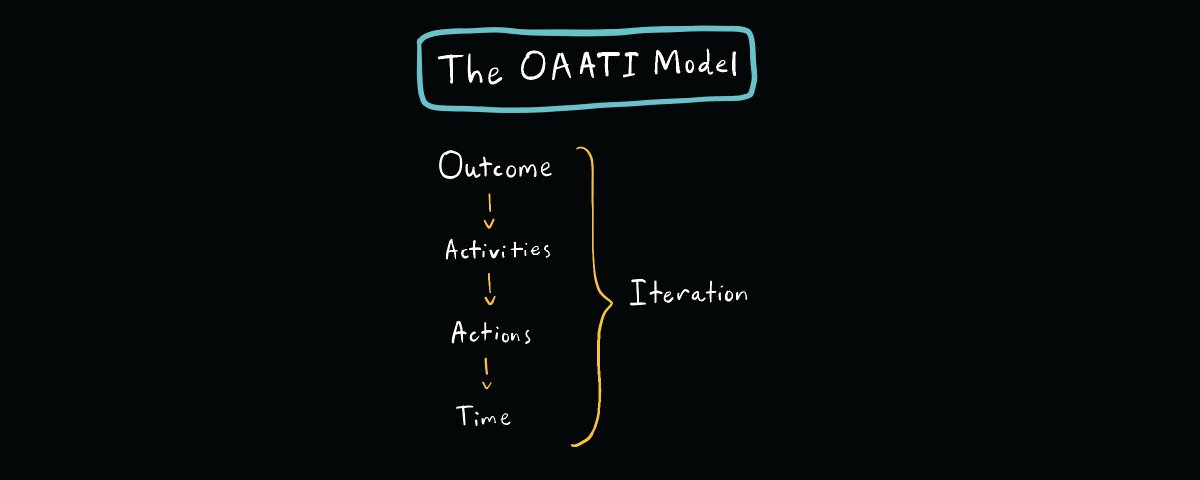
原图文字:Outcome=结果;Activities=活动;Actions=行动;Time=时间;Iteration=迭代。
I have tried every productivity system there is, watched all the videos, read most of the books, and after years of doing that, I still had no idea how to reach a single one of my goals.
我试过各种效率管理体系,看过所有相关视频,读过大多数相关书籍。折腾了这么多年,我却仍然不知道该怎样实现自己的任何一个目标。
Until I found these five words, that is.
直到我发现了这五个词。
To not waste your time here:
为了不浪费你的时间,我直说:
All the advice on how to achieve your goals is so complicated and vague.
那些关于如何实现目标的建议,都太复杂、太模糊了。
And all the advice online only gives you tiny pieces of a much larger picture.
而网上的各种建议,只给了你一幅更大图景中的零星碎片。
People are addicted to doing things that simply don’t matter.
人们沉迷于做那些根本不重要的事情。
Some people swear by deep work. Others swear by time blocking. Some promise that analog is superior to digital. Or no, digital will always be better than analog, because you have the newest productivity app or software getting vibe coded each day. What about Notion templates, and morning routines! Wait… no morning routines? Which is it?
有人坚信深度工作,有人推崇时间块管理。有人保证纸笔一定胜过数字工具。也有人说,不对,数字工具永远更好,因为每天都有靠 AI 编程做出来的新效率应用。那 Notion 模板呢?晨间习惯呢?等等……又说不需要晨间习惯?到底该听谁的?
Sorry.
抱歉。
They are all tiny nodes in a spider’s web. Individual pieces to a big picture puzzle that are pointless in isolation.
它们不过是蜘蛛网上的一个个小节点,是整幅拼图中的零件。孤立地看待它们,并没有什么意义。
Most people will spend their lives doing pointless things that feel productive.
大多数人会用一生去做毫无意义、却让自己感觉很有效率的事。
You’re doing it already.
你已经在这样做了。
You’ve done it today, yesterday, and you’ve wasted more hours than you can count across your ten fingers.
今天如此,昨天如此。你浪费的时间,早就不是掰着十根手指能数清的了。
All your life problems exist in the vague. Because fear and laziness don’t live in the specific.
你生活中的问题,都藏在模糊之中。因为恐惧和懒惰,在具体明确的事情里无处容身。
You’ll believe you’re lazy if you don’t have a plan.
没有计划,你就会以为自己很懒。
You’ll live your life in fear unless you clear the fog in your own mind.
不清除脑海里的迷雾,你就会一直活在恐惧之中。
These five words are your guiding light for clearing that fog.
这五个词,就是帮你驱散迷雾的指引。
Outcome → Activities → Actions → Time → Iterate
结果 → 活动 → 行动 → 时间 → 迭代
I call it The OAATI Model (pronounced “oat-ee”).
我把它称为 OAATI 模型,读作“oat-ee”。
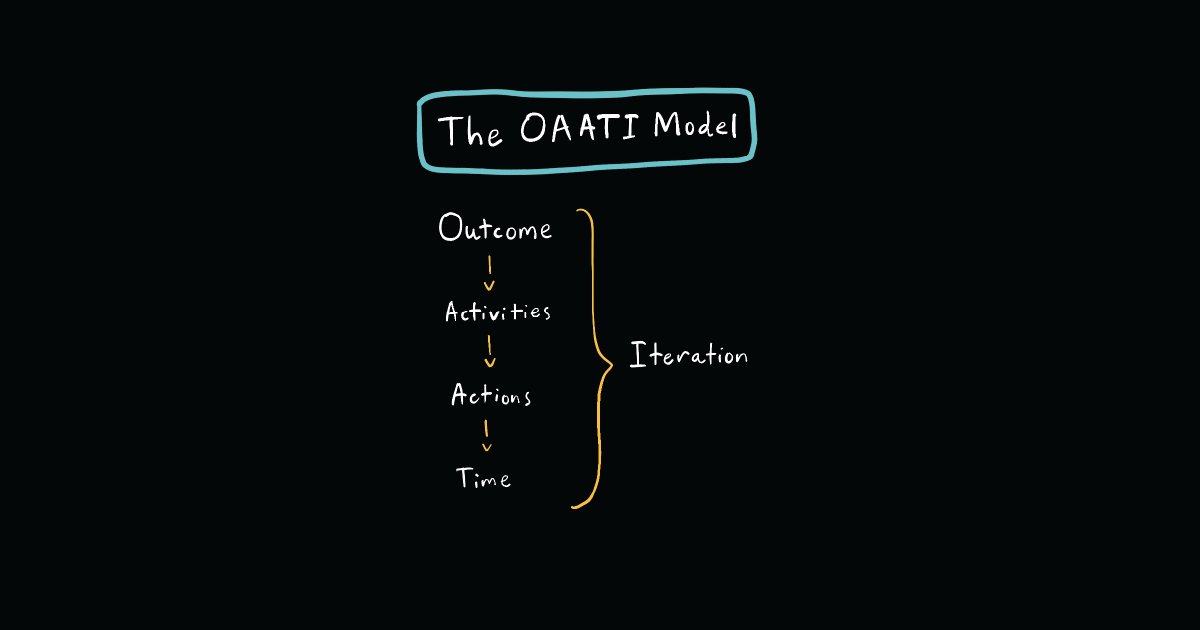
OAATI 模型:将结果逐层拆成活动、行动和时间,并对各个环节持续迭代。
This newsletter has a single purpose:
这期通讯只有一个目的:
Give you absolute clarity on what to do for achieving anything.
让你彻底弄清楚,为了实现一件事,究竟应该做什么。
I can’t promise this will be the most emotionally investing piece of writing. We have lots of logic to run over.
我不能保证这会是一篇让人情绪澎湃的文章,因为我们有很多逻辑需要梳理。
This will be dull for a lot of people.
对不少人来说,这会很枯燥。
Which is why a lot of people will never achieve a single one of their goals, ever, and live an 80-year life of quiet desperation.
这也正是为什么,许多人终其一生都实现不了任何一个目标,在无声的绝望中度过八十年。
The only thing I can promise is that you’ll have everything you need to build upon what I’m going to give you.
我唯一能保证的是,你会得到所需的全部基础,能够在我接下来提供的内容之上继续构建自己的方法。
Here’s how you can achieve any goal with this model:
下面就是用这个模型实现任何目标的方法:
- Define one clear/measurable outcome
- Break it into activities, lists of single actions, and time needed to complete each action (so you can time block with a calendar)
- Test every part, and cut what fails
- Find your one constraint limiting you from launching into the next stage of your life
- Systematize everything else
- Iterate and course correct until you achieve your outcome
- 明确一个清晰、可衡量的结果。
- 将它拆成活动、具体行动清单,以及完成每项行动所需的时间,这样就能在日历上安排时间块。
- 检验每个部分,删去不起作用的内容。
- 找到那个阻碍你进入人生下一阶段的关键瓶颈。
- 将其他部分系统化。
- 持续迭代、修正方向,直到实现预期结果。
Ready to have absolute clarity on how to achieve literally any goal?
准备好彻底弄明白,怎样实现任何一个目标了吗?
Me too :)
我也准备好了 :)
Let’s do some profound thinking together!
一起来做些深入思考吧!
一、目标与结果没有区别
1 - There is no difference between a goal and an outcome
(一)什么是目标
(a) What is a goal?
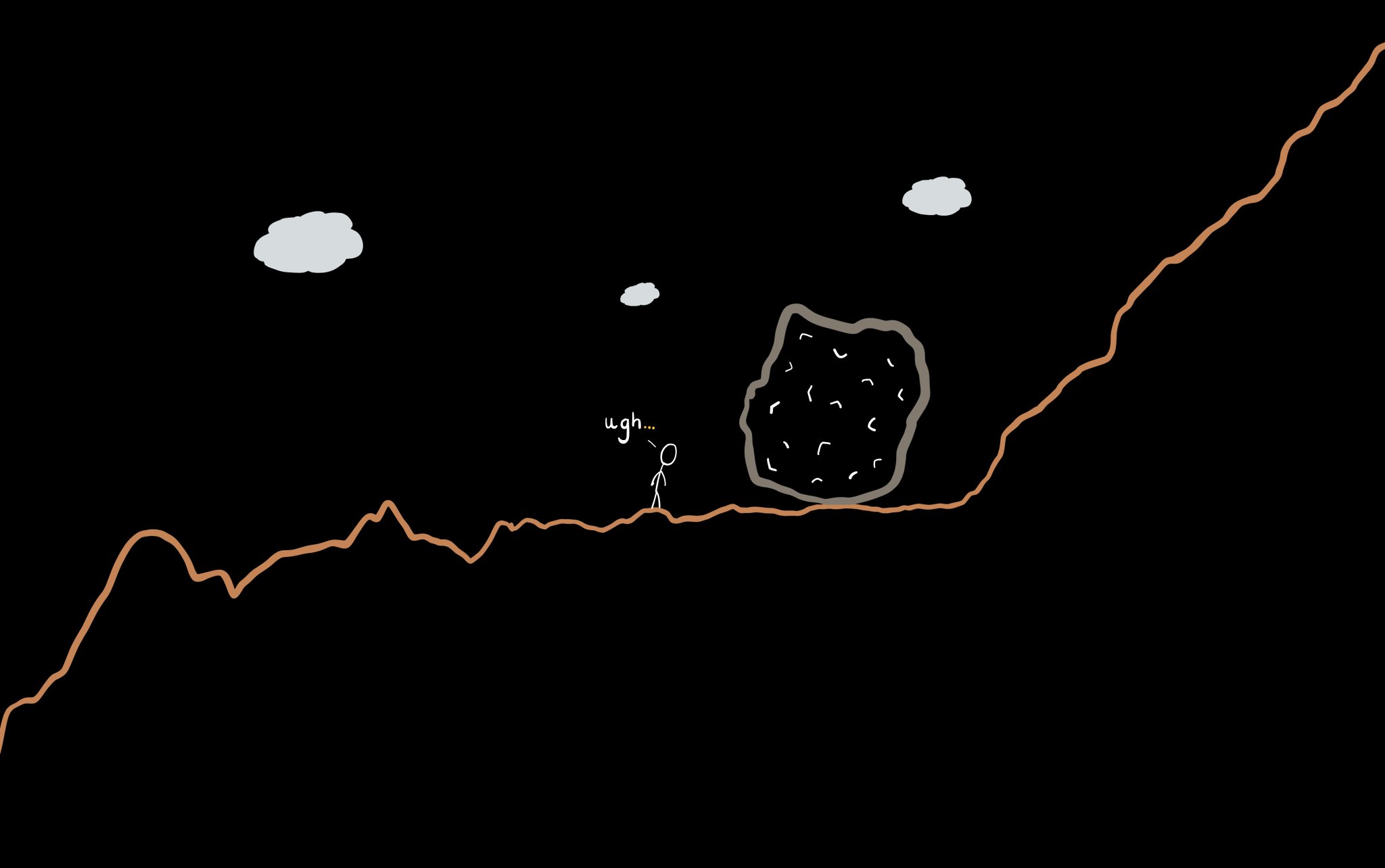
原图中的“ugh…”表示吃力的叹息:明确目标,才能知道石头应推向哪里。
Let me ask you.
我想问你一个问题。
When you have a goal, what appears in your mind?
当你有一个目标时,脑海里浮现的是什么?
Well, it’s a vision of reality.
是一幅现实的图景。
It’s an image of something physical, tangible, and measurable.
是某种具体、可触及、可衡量的事物的画面。
Have you ever heard of a man named Stanley Kubrick? He’s considered to be one of the greatest filmmakers who ever lived. Kubrick once said a very profound idea, that if it can be thought of, it can be filmed.
你听说过斯坦利·库布里克吗?他被认为是有史以来最伟大的电影导演之一。库布里克曾说过一句很有启发的话:只要能够想象出来,就能够拍成电影。
You’re allowed to view your goals in the same way.
你也可以这样看待自己的目标。
I’ll tell you a story.
给你讲个故事。
I was catching up with my dad during the week, and I was telling him about The OAATI Model. I used a relevant example for him.
这周和爸爸聊天时,我向他介绍了 OAATI 模型,并用了一个与他有关的例子。
Golf.
高尔夫。
I haven’t played much golf, and I’ll try keep this brief. Just so I don’t bore you if you haven’t either.
我打高尔夫不多,所以会尽量讲得简短一些,免得你也不打球,听着觉得无聊。
I actually think using an example of something you do find boring actually reveals a lot more about goal setting that you might realize.
其实我觉得,用一件你觉得无聊的事情举例,反而能让你看清更多关于目标设定的道理。
If you have what’s called a single handicap in golf, you’re considered a golfer.
在高尔夫里,如果你的差点达到所谓的个位数水平,就算得上是个真正会打球的人了。
Put simply, a golf handicap is a number that measures your golfing ability so that people of different skill levels can compete fairly against each other.
简单来说,高尔夫差点是衡量球技的一个数值,让水平不同的人也能公平竞争。
The single outcome (goal) for this example is 9.9.
在这个例子中,唯一的结果,也就是目标,是把差点降到 9.9。
Remember.
记住。
This is a clear and tangible outcome.
这是一个清晰、具体的结果。
You can see and measure it.
你能看见它,也能衡量它。
See how unvague it is? It’s more concrete than a brick wall.
看出它有多明确了吗?简直比砖墙还要实在。
The insight:
这里的关键是:
You need one outcome.
你需要一个结果。
It can be anything. Learn to write high-impactful long form content under a personal brand, get to a single handicap in golf, cook nicer fillet steaks, build some fucking confidence that lasts longer than 30 seconds, watch Game of Thrones as fast as possible (especially the last season)…
它可以是任何事:学会以个人品牌写出有影响力的长文,把高尔夫差点降到个位数,煎出更好吃的菲力牛排,建立一点真正能持续超过三十秒的自信,尽快看完《权力的游戏》,尤其是最后一季……
ANYTHING.
任何事都可以。
But is has to be one thing. The clearer you define the outcome the better. It can iterate and evolve, so you just need any outcome to begin with.
但必须先选一件。结果定义得越清楚越好。它以后可以迭代、演变,所以一开始只需要先选定一个结果。
Direction is more important than having a perfect outcome to begin with. But it still has to be a single outcome.
先有方向,比一开始就把结果定义得完美更重要。但它仍然必须是一个单一的结果。
(二)如何选择目标
(b) How to pick your goal
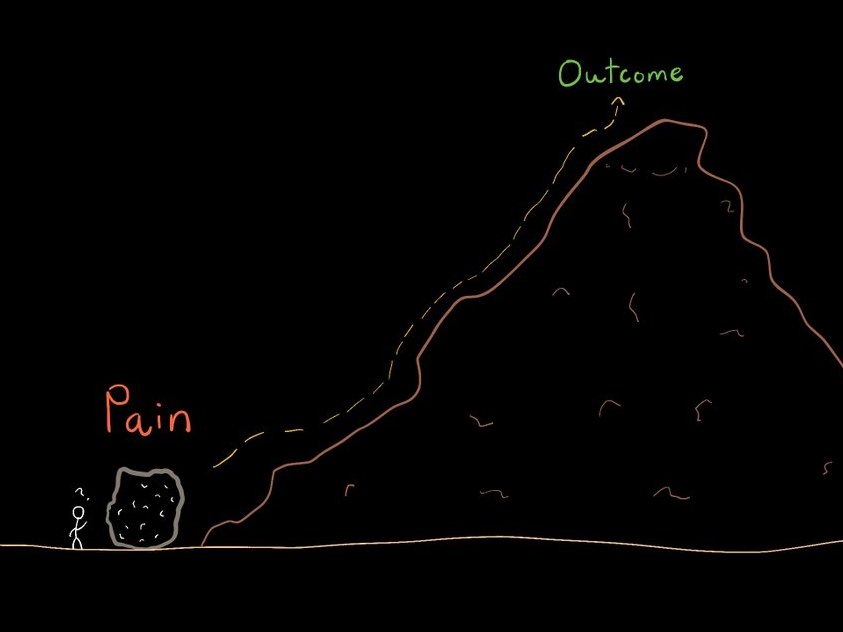
原图文字:Pain=当前痛苦;Outcome=预期结果。山脚是起点,山顶是目标。
Have you ever heard of a man named Sisyphus?
你听说过西西弗斯吗?
I never go too long without mentioning this book, I’ve written about it a lot.
我总是忍不住提起这本书,也已经围绕它写过很多文章。
Sisyphus is that guy who got condemned by the Gods (ya know, as you do) to push a rock up a mountain for eternity. And just before it reaches the top, it will roll back down again, every time, repeating for the rest of… you get the idea.
西西弗斯被众神惩罚,要永远把一块石头推上山。你也知道,神话里就是会发生这种事。每次快到山顶时,石头都会滚下去,如此循环,直到永远……你懂的。
Let’s use Sisyphus as our role model here.
这里不妨把西西弗斯当作我们的榜样。
You need a mountain.
你需要一座山。
The top of the mountain is your outcome. That’s the summit.
山顶就是你想要的结果,是你的顶峰。
The bottom of the mountain is your current pain. That’s your baseline. Whatever suffering you will continue to endure unless you start climbing.
山脚则是你目前的痛苦,是你的起点。如果不开始攀登,你就会继续承受这些痛苦。
You need to pick a heavy rock to push. Like Sisyphus.
你得选一块沉重的石头来推,就像西西弗斯一样。
And you need to choose your own mountain. It’s all well and good pushing a rock around in circles. But going in circles will never lead you anywhere other than in a circle.
你还得选一座属于自己的山。推着石头原地转圈当然也能忙个不停,但兜圈子只会让你继续留在圈子里。
You need to push upward as opposed to around.
你需要向上推,而不是绕圈推。
(三)定义目标及其反面
(c) Define your goal (and its opposite)
How do you define your outcome, the top of the mountain you’ll be climbing?
怎样定义你想要的结果,也就是准备攀登的那座山的山顶呢?
Well, you ask yourself some questions.
可以问自己几个问题。
- What would it feel like?
- What would it look like or appear like in conversation or a specific setting?
- What would you be feeling, thinking, saying, and doing?
- 实现它会是什么感觉?
- 在一次对话或某个具体场景中,它会呈现出什么样子?
- 到那时,你会有什么感受、想法,会说什么、做什么?
That’s your summit… but what about your baseline?
这就是你的山顶……那你的起点呢?
You invert your summit.
把山顶的样子反过来想。
Flip it.
翻转它。
- What would it NOT feel like?
- What would it NOT look like or appear like in conversation or a specific setting?
- What would you NOT be feeling, thinking, saying, and doing?
- 它不会是什么感觉?
- 在一次对话或某个具体场景中,它不会呈现出什么样子?
- 你不会有什么感受、想法,不会说什么、做什么?
Motivation comes from urgency. Which means you need an enemy to run from.
动力来自紧迫感。这意味着,你需要一个必须远离的对手。
Profound Idea: Sometimes the best way to launch yourself into a new way of life, is to give yourself a fire under your arse that actually gets you sweating a little.
**深刻想法:**有时,迈向一种新生活的最好办法,就是给自己一点真正让人坐不住、甚至开始冒汗的压力。
Think of exactly what you do not want.
准确想清楚,你究竟不想要什么。
Reverse engineer why that failure would have happened. What mistakes were made? From there, make your version one mountain. Think of this like a first draft you know will get destroyed, rebuilt, and always keep evolving.
倒推那种失败为什么会发生:到底犯了哪些错误?以此为基础,画出第一版属于你的山。把它当作一份初稿,你知道它会被推翻、重建,并且不断演变。
Something specific enough to act on and start getting feedback from (which you can use to evolve it as you yourself evolves through iteration).
它只需要具体到足以让你行动,并开始获得反馈。随着你通过迭代不断成长,也可以用这些反馈来完善它。
Our first step is to define one outcome.
第一步,是定义一个结果。
Then define the bottom of your mountain to climb away from. The outcome you don’t want.
然后定义你要远离的山脚,也就是那个你不想要的结果。
My 23 years of being alive has taught me so much and so little. However, I personally believe there are voluntary, meaningful, and better problems, as opposed to involuntary, avoidable, and worse off problems.
活了二十三年,我学到了很多,也依然懂得很少。但我个人相信,有些问题是主动选择的、有意义的、相对更好的;另一些则是被迫承受的、本可避免的、让境况更糟的。
I’d much rather take my pick from the first boat as much as possible.
只要有选择,我更愿意尽量选择前一类。
You have to pick your poison, because either way, you’re all in.
你必须选择自己愿意承受的苦,因为不管选哪条路,你投入的都是整个人生。
If you don’t have a mountain, if you can’t define your baseline and summit, if you can’t give yourself just one single outcome to aim at, good luck.
如果你没有一座山,定义不了自己的起点和山顶,也无法给自己选定一个结果,那就只能祝你好运了。
I don’t know what to tell you if you can’t start with that. Even a poorly defined single outcome at first.
如果连这一步都无法开始,我也不知道还能说什么。哪怕一开始,这个单一结果定义得很粗糙也没关系。
Just choose one, then do this.
先选一个,再做下面的事。
二、将结果拆成活动、行动清单与时间
2 - Every outcome breaks down into activities, a single list of actions, and time
(一)选定目标之后做什么
(a) What to do once you’ve picked a goal
The outcome always comes first.
结果始终排在第一位。
You work backwards from the goal you want to achieve.
你要从想实现的目标出发,倒着推演。
Which will lead you onto the next few letters of the model:
接下来就会用到模型中的另外几个字母:
- Activities are categories of work that each consist of a list of single actions in sequence
- Actions are the deathly specific tasks within each activity
- Each action takes a distinct amount of time (you time block or use a calendar to schedule time to complete actions)
- **活动(Activities)**是不同类别的工作,每类工作都包含一份按顺序排列的具体行动清单。
- **行动(Actions)**是每项活动中极其具体的任务。
- 每项行动都需要一定的时间(Time),可以通过时间块或日历安排来完成。
Notice, finally, how every other productivity system only ever gives you fragments of this big picture?
现在你终于看出来了吗?其他效率管理体系往往只给了你整幅图景中的一部分。
That objective big picture is what nobody seems to talk about… for whatever fucking reason. Or in a clear, simple way at least.
却似乎没人讨论这幅完整的图景,真不知道是为什么。至少,没人把它讲得清楚、简单。
Back to the golf outcome we had:
再回到前面的高尔夫目标:
Single handicap is the goal. The 9.9 handicap.
目标是个位数差点,也就是 9.9。
Although I don’t know much about golf (it’s been years since I’ve played), while talking to my dad, I myself broke that outcome down into three activities:
虽然我不太懂高尔夫,距离上次打球也已经过去好多年了,但和爸爸聊天时,我还是把这个结果拆成了三项活动:
- Driving the ball from the tee spot
- Getting the ball to the green
- Putting the ball into the hole
- 从发球区开球。
- 将球打上果岭。
- 将球推进球洞。
This is far from being a perfect breakdown of activities.
这样的活动拆解远远称不上完美。
But it’s done.
但它已经做出来了。
You can’t iterate (improve) something that does not exist.
你无法迭代,也就是改进一个根本不存在的东西。
More on iteration later friend.
朋友,关于迭代,我们后面再说。
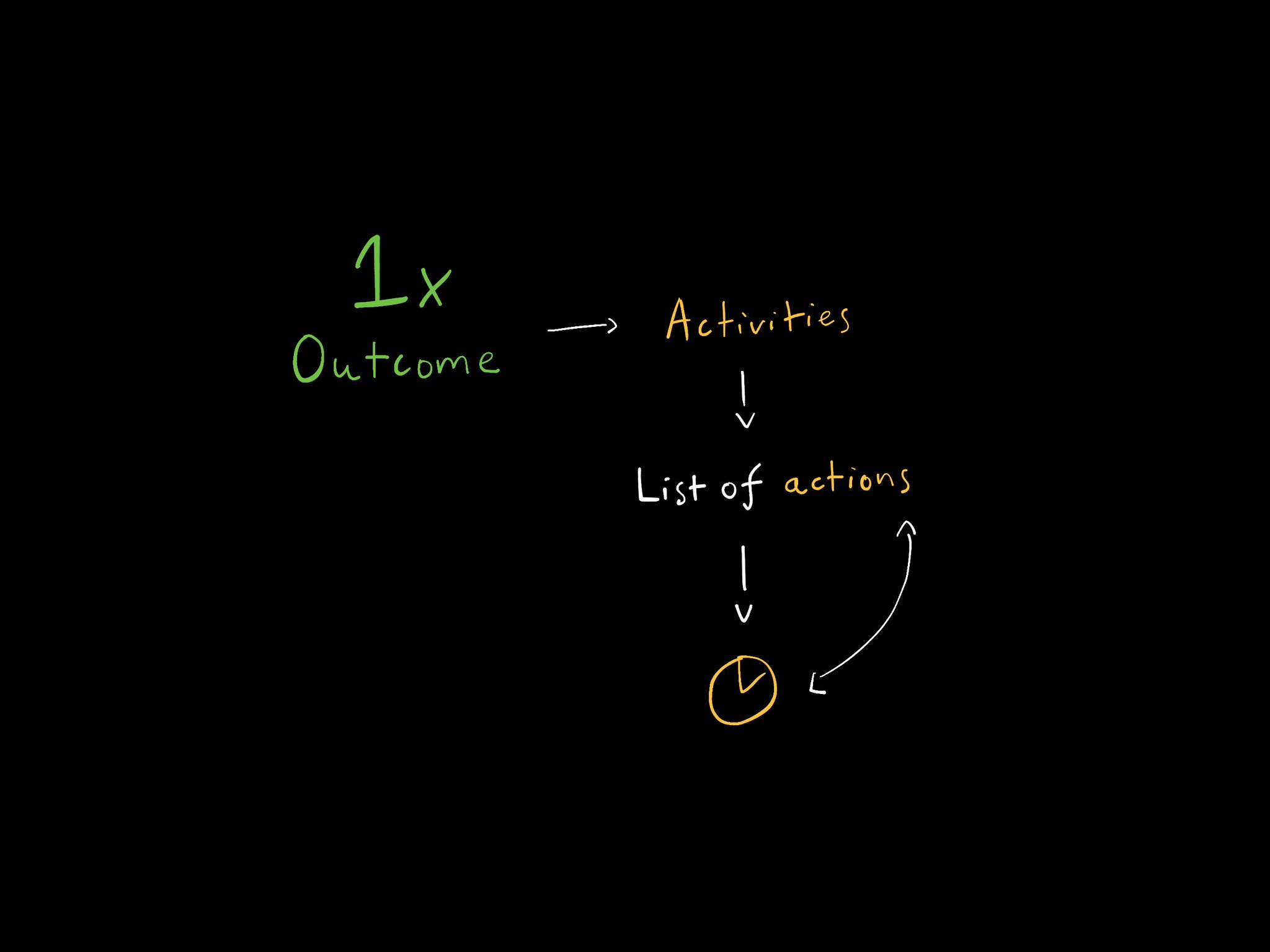
原图文字:1× Outcome=一个结果;Activities=活动;List of actions=行动清单;时钟表示所需时间。
Listen.
听我说。
If I myself had more reps from playing golf, which means more feedback from reality, I would have broken down the activities list with more confidence. I’d have more confidence on what single actions I would need to make too for each activity. I really want you to understand this idea.
如果我打过更多次高尔夫,也就是从现实中获得过更多反馈,那么拆解活动清单时就会更有把握。对于每项活动需要哪些具体行动,我也会更清楚。我真的希望你理解这一点。
Your ability to break down your goals into its parts improves as your experience does.
随着经验增加,你把目标拆成各个部分的能力也会提高。
Experience requires feedback.
经验需要反馈。
You need to do things.
你需要真正去做事。
Live your life. Reflect on your mistakes. What went well or not. Then you iterate somewhere across those five words across the OAATI model.
去生活,反思自己的错误,看看哪些做得好、哪些不好。然后在 OAATI 模型的这五个环节中,找到需要迭代的地方。
This entire model is quite literally everything you need to achieve your goals.
这个完整的模型,就是你实现目标所需要的全部框架。
The only other thing you need is iteration so you can course correct.
除此之外,你还需要不断迭代,才能修正方向。
(二)实现目标的两类行动步骤
(b) Two types of action steps for achieving any goal
What about each activity itself?
那么,每项活动本身该怎么处理?
Well, you have a list of single actions (an example will do wonders for you here).
你需要列出一份具体行动清单。这里用例子说明,会特别有帮助。
There are two types of action steps:
行动步骤可以分成两类:
- Rigid Steps - These are mechanical. Like editing a checklist, organizing your calendar, or brushing your teeth all the way from grabbing toothpaste to cleaning those sparkly whites
- Loose Steps - These are creative. Think idea generation, painting (as opposed to mechanically taking out your paints, brushes, and canvas) or live rolling in jiu-jitsu
- 固定步骤(Rigid Steps):机械性的操作。例如修改检查清单、整理日历,或者刷牙时从拿起牙膏到把牙齿刷干净的整个过程。
- 开放步骤(Loose Steps):需要创造性的行动。例如构思点子、绘画本身,而不是机械地拿出颜料、画笔和画布,或者柔术中的实战对练。
Both types of steps are specific, but neither is vague.
这两类步骤都很具体,都不应该含糊。
Vagueness is the enemy, not specificity.
需要对抗的是模糊,而不是具体。
There’s two sides of the internet that love to go to war with each other. The productivity group love to systematize everything, and the creativity group assume they live hollow lives, and feel shallow on the inside because they live like robots. They don’t do anything for the sake of itself… which is why the creativity group usually get nothing done, and can’t market the value of their content for shit, and don’t achieve as many real world outcomes as opposed to the productivity group. On the surface, it looks like a battle for success and wholeness between the two groups - and that you can’t have both.
网上有两群人特别爱互相争论。效率派喜欢把一切系统化;创意派则觉得他们像机器人一样生活,内心空洞,从不单纯为了事情本身去做一件事。可创意派往往也因此什么都做不成,连自己内容的价值都推广不好,在现实中取得的成果也不如效率派多。表面上,这像是一场在成功与内在完整之间展开的争执,仿佛两者无法兼得。
Wrong.
这种看法错了。
Understanding the distinction between rigid and loose steps is what integrates both sides here.
理解固定步骤和开放步骤的区别,就能把这两方面结合起来。
Productivity and creative freedom.
也就是效率与创作自由。
If you understand that rigid steps build the foundation for creativity, flow, and adaptation, you will win.
如果你明白固定步骤是在为创造力、心流和灵活应变打基础,你就掌握了关键。
Rigid steps can’t be ignored. Things like making a long-form content template or checklist, or curating topics to write about, or making a system for how to go about outlining a long-form post, those things can be systematized.
固定步骤不能忽略。比如制作长文模板或检查清单、整理待写选题,或者建立长文提纲的制作流程,这些事情都可以系统化。
They don’t require creativity.
它们本身不需要创造力。
But they build the groundwork to let you dance upon, and be creative about what you write about in your long form post, or how you let your taste define the finished product, or what key points you choose to place within your outline.
但它们搭好了基础,让你能自由发挥:长文究竟写什么,如何用自己的品味塑造最终作品,以及在提纲中选择哪些关键论点。
Rigid steps maintain order so that creativity can dance chaotically and freely.
固定步骤维持秩序,让创造力能够不受拘束、自由起舞。
Another example, just to send this point home.
再举一个例子,把这点说透。
I am a jiu-jitsu blue belt. A shit one, to say the least.
我是柔术蓝带。坦白说,水平挺烂。
The rigid steps, for me, involve showing up twice per week, warming up with these weird hip stretches I do (or not warming up at all… yikes!) and drilling a specific footsweep I want to work on that week.
对我而言,固定步骤包括每周去训练两次,做那些有点奇怪的髋部拉伸来热身,有时甚至干脆不热身,想想都让人捏把汗;还有练习那周想掌握的某个扫脚动作。
The loose steps are where I get to let loose.
开放步骤则是让我放开手脚的部分。
You can’t script what happens in a live round. You can’t predict it. Do you think anyone can predict exactly what might happen in a boxing match or a UFC fight? No, but the rigid steps serve the unpredictability. The creativity.
你无法为一轮实战写好剧本,也无法预测过程。谁能准确预言拳击赛或 UFC 比赛中会发生什么呢?没有人。但固定步骤,正是在为这种不可预测性和创造力服务。
How I engage with my opponent, how I respond. Do I wrestle or pull guard, do I attack the legs or look for a triangle choke?
我要如何与对手交锋,怎样回应?是摔跤还是拉入防守位?是进攻腿部,还是寻找三角绞的机会?
My point is that principles and chaos are allowed to meet.
我的意思是,原则与混沌可以相遇。
You will become more creative and to a higher quality once you give yourself constraints.
给自己设定约束之后,你反而会更有创造力,创作质量也会更高。
(三)越熟练,需要记录的行动步骤就越少
(c) The more skilled you are, the less action steps you need to track
The more skilled you are, the fewer actions you need, or the less specific you have to be about doing them.
你的技能越熟练,需要的行动步骤就越少,或者不必再把每一步记录得那么细。
This is all built upon the philosophy of SOPs (standard operating procedures).
这背后的理念,就是 SOP,也就是标准操作流程。
An SOP you’re running for the first time writing a Substack newsletter from blank page to published post might have 80 steps.
第一次用 SOP 撰写 Substack 通讯时,从空白页面一直到发布文章,你的流程可能足足有八十步。
I’m being serious.
我是认真的。
But an expert might only have 50 steps after cutting, asking “why am I doing this” at every action and activity, and separating the wheat from the chaff after iterating that SOP (to improve it based on data/feedback) after writing 10 long form posts and getting tons of feedback doing so.
但一个熟手写完十篇长文、获得大量反馈之后,会迭代 SOP,根据数据和反馈加以改进,并在每项活动、每个行动上追问“我为什么要做这个”。经过删减、去掉无用部分,流程可能就只剩五十步了。
All of this probably seems very overwhelming for you right now.
现在听起来,这一切可能让你觉得难以招架。
But please know that all things you’ve never tried before feel like that.
但请记住,任何从未尝试过的事情,一开始都会让人有这种感觉。
Profound Idea: New things feel uncomfortable at first, until you do more of those things, before getting better at those things.
**深刻想法:**新事物最初总让人不舒服。多做一些,才会逐渐变得熟练。
Once it’s written down once, the entire SOP from activity one, action one, to the final activity and last action, you never have to do it again.
只要把完整的 SOP 写过一次,从第一项活动的第一个行动,直到最后一项活动的最后一个行动,以后就不必再从头写一遍。
You only have to improve it from there.
你只需要在它的基础上持续改进。
Write it all down, every activity, list of action steps (rigid or loose), and the time it takes to complete each activity, even if none of it is perfect at first. Do it in a word document in Notion, Eden, Obsidian, or the notes app in your phone.
把所有内容都写下来:每项活动、固定或开放的行动步骤清单,以及完成每项活动所需的时间。哪怕最初都不完美,也先写出来。你可以用一份文字文档,放在 Notion、Eden、Obsidian,或者手机备忘录里。
You only need one document. It’s that little.
只需要一份文档,就这么简单。
Then you can improve it. Because it exists now.
接着就可以改进它,因为它已经存在了。
I promise that you will not believe how much clarity you will gain. Let alone how much progress and iteration and thus learning and self-development you can do in 2-3 months with a single SOP document.
我保证,你会惊讶于自己能变得多么清晰。更不用说,只凭一份 SOP 文档,在两三个月里就能取得多少进步、完成多少次迭代,以及由此产生多少学习和个人成长。
One word document for achieving one meaningful outcome you’ve kept failing to achieve until now.
用一份文字文档,去实现那个有意义、却至今反复未能实现的结果。
三、用是什么、为什么、如何检验每个部分,并大幅删减
3 - Test each part by asking what, why, and how, and cut like a maniac
(一)对每项活动追问是什么、为什么、如何
(a) Ask yourself what-why-how for each activity
That was heavy, what we just went through.
刚才讲的内容很密集。
As I always recommend, you should listen to this on a walk or on multiple walks.
和我一直建议的一样,你可以散步时听这篇文章,也可以分几次散步慢慢听。
For what actions you take, so, the rigid and loose types beneath each activity, use the what-why-how framework.
对于每项活动下的行动,无论是固定步骤还是开放步骤,都可以使用“是什么—为什么—如何”这个框架。
- What is this action?
- Why am I doing it?
- How does it move me toward my outcome in relation to where I am right now?
- 这个行动是什么(What)?
- 我**为什么(Why)**要做它?
- 相对于我目前的位置,它**如何(How)**推动我接近预期结果?
This is how you (1) build out your action steps when starting all this, and (2) how you maintain it during iteration.
这个方法既能帮助你在起步时建立行动步骤,也能帮助你在后续迭代中维护它们。
The reason you can’t move forward within any domain of your life, is almost always because you’re doing actions that you can’t explain WHY you’re doing them.
你在人生的某个领域无法前进,几乎总是因为你在做一些连自己都解释不清“为什么要做”的行动。
I want you to pause and think about what I just said for 20 seconds…
我希望你暂停二十秒,想想刚才这句话……
(二)例子:我犯过的蠢
(b) Example: me being an idiot
Let me tell you a little story.
给你讲个小故事。
I was building a learning system for a long time. 2 months at least. And all I kept doing was building and updating the system, trying to make it perfect. But I wasn’t reading. I wasn’t reading books. I had no feedback because I was doing everything but move toward my outcome… build a broad but intuitive understanding of the books on my reading list.
我花了很长时间搭建一套学习系统,至少有两个月。期间一直在搭建、更新,试图把它做到完美。可我根本没有在阅读,没有在读书。我得不到反馈,因为做了那么多事情,却没有真正接近我的结果:对阅读清单上的书,建立广泛而直观的理解。
Using the what-why-how:
用“是什么—为什么—如何”来检查:
- Why am I updating this system right now? So I can improve my comprehension skills while reading.
- Does doing this right now move me toward reading more and understanding more books? No, because I’m not actually implementing enough and getting real feedback that would justify making updates to my system.
- 我为什么现在要更新这套系统?为了提高阅读时的理解能力。
- 现在做这件事,能让我读更多书、理解更多书吗?不能,因为我还没有充分实践,没有获得足以支持这些系统更新的真实反馈。
So why fucking do it?
那我到底为什么还要做?
That was the aha moment for me.
那一刻,我突然想明白了。
(三)这套方法也适用于抽象目标
(c) This works for abstract goals, not just physical goals
What’s the difference between the two?
抽象目标和具体目标有什么不同?
Think “improve my confidence” as opposed to “build this IKEA shelf.”
想想“提升自信”和“装好这个宜家书架”之间的区别。
You just need to be incredibly clear and precise with defining your summit (what would confidence feel like to you, look like to you and others, and appear like to you and others in conversation?) and your baseline (the opposite of your summit answers).
你只需要极其清晰、准确地定义自己的山顶:自信对你来说是什么感觉?在你和别人眼里是什么样子?在对话中又会怎样呈现?同时,也要定义起点,也就是这些答案的反面。
Then you would break those down into activities, with each activity having a single list of actions.
然后把它们拆成活动,每项活动再列出一份具体行动清单。
Then you test the life out of each one by asking what-why-how WHILE you are going out and following the damn actions and activities with your time.
接着,一边真正投入时间去执行这些活动和行动,一边用“是什么—为什么—如何”反复检验每一项。
It’s harder, dirtier work to do this than with say a physical, concrete outcome.
与实现某个具体、可见的结果相比,这项工作更难,也更琐碎。
You need to be even more specific and clear about what success looks like for achieving an abstract goal, compared to a physical goal (getting a single handicap is more measurable than a 50% improvement in confidence).
对于抽象目标,你需要更具体、更清楚地定义成功的样子。把高尔夫差点降到个位数,比“自信提高 50%”更容易衡量。
But the model still works. You just have to be willing to do the dirty work that is necessary.
但这个模型仍然适用。你只需要愿意做那些必要的、繁琐的工作。
Here’s something that annoys me (that most people cannot do).
有件事让我很恼火,也是大多数人都做不到的:
Most people can’t state what they believe clearly, let alone why it is true or how it is relevant.
大多数人连自己相信什么都说不清楚,更不用说解释它为什么成立,以及它有什么关联。
So do this for me now:
所以,现在请这样做:
- Take your current list of actions for each activity (assuming you defined those, even poorly for now)
- Question each activity by asking what, why, and how
- Then question each action within each activity by asking what, why, and how
- Cut or restructure anything that fails that test
- 拿出每项活动对应的行动清单,假设你已经写过,哪怕目前还很粗糙。
- 用“是什么、为什么、如何”逐项审视活动。
- 再用同样的问题,审视每项活动中的每个行动。
- 删除或重构任何经不起检验的部分。
You can read more about how to use the what-why-how thinking framework for making your thinking clearer, and therefore more deadly, by reading this post (once you’ve finished reading this one).
读完本文后,可以阅读这篇文章,了解如何用“是什么—为什么—如何”思考框架,让思路更清晰,也更有力量。
四、你正在做的大部分工作,其实毫无意义
4 - Most of the work you’re doing is absolutely, totally pointless
There, I said it.
没错,我就是这么说的。
What you need is to find your constraint instead.
你真正需要做的,是找到自己的瓶颈。
(一)约束理论
(a) Theory of Constraints
In his book The Goal, written in 1984 (and it’s still relevant today), Dr Eliyahu Goldratt outlined his concept known as the theory of constraints.
在 1984 年出版、至今仍有现实意义的《目标》一书中,埃利亚胡·高德拉特博士阐述了所谓的约束理论。
It states:
它的观点是:
Every system has at least one constraint limit it’s performance, and improving that constraint is the only thing that improves the whole system.
每个系统都至少有一个限制其表现的瓶颈,而改善这个瓶颈,才会改善整个系统的表现。
Goldratt got this idea while on a hike with boy scouts. He noticed that the slowest walker determined the pace, and thus the arrival time of the entire group. Speeding up the fastest walkers wouldn’t have done anything… but the slowest walkers?
高德拉特是在和童子军徒步时产生这个想法的。他注意到,走得最慢的人决定了整支队伍的速度,也决定了到达时间。让最快的人走得更快,并不会改变什么……但如果改善最慢的那个人呢?
Glorious. It’s almost too good an analogy to use.
太妙了。这几乎是个再合适不过的比喻。
Find your slowest walker and light a fire under their arse.
找到你队伍里走得最慢的人,给他一点必须加快脚步的压力。
Maybe don’t do that… I’m being metaphorical here trust me (haha).
当然,别真在人家屁股底下点火……相信我,这只是个比喻,哈哈。
Your activities and actions are the scouts. One of them will always be the slowest. ALWAYS. And when one of them no longer becomes the slowest walker, another one will.
你的活动和行动,就像那些童子军。总会有一个最慢的,始终如此。而当它不再是最慢的那个时,另一个就会成为新的瓶颈。
That is the theory of constraints.
这就是约束理论。
Guess what?
你猜怎么着?
The what-why-how framework will help you find yours.
“是什么—为什么—如何”这个框架,可以帮你找到自己的瓶颈。
(二)例子:我又犯过的蠢
(b) Example: me being an idiot (again)
When I was in secondary school I spent four hours each night studying from 6pm to 10pm…
上中学时,我每天晚上都会从六点到十点,花四个小时学习……
“studying”…
所谓的“学习”……
I say studying and not learning.
准确地说,我是在埋头用功,却没有真正学会。
I never identified the specific gap between where I was and where I needed to be, in relation to what the curriculum required.
我从来没有对照课程要求,找出自己目前的水平与需要达到的水平之间,具体差在哪里。
You know those learning outcomes you see at the start of each chapter of your school books?
你记得课本每章开头列出的那些学习目标吧?
Or the learning outcomes they talk to you about once, in one 15 minute conversation at the start of the school year, and forget to mention again or even call back to while teaching, and instead give you vague instructions on what you need to be learning, and why it’s relevant, in their eyes, and not based on what you are very specifically getting tested on at the end of the year…
或者,老师在学年开始时花十五分钟讲过一次,之后在教学中却不再提起、也不再对应说明的那些学习目标。取而代之的,是含糊地告诉你该学什么,以及这些内容在他们看来为什么重要,却不以学年末究竟会考查你的哪些具体能力为依据……
Yeah.
没错。
If I had found my one constraint (either a subject or concept that was limiting my progress the most) I could have spent one hour learning each day, and spent the rest lifting weights and playing guitar and doing anything else.
如果我当时找到了那个关键瓶颈,无论是最妨碍进步的一门学科,还是某个概念,我本可以每天只花一小时真正学习,把剩下的时间用于举铁、弹吉他,或者做别的事。
I made a painful mistake (a time costly one too) of sacrificing quality of work for the metric of hours worked.
我犯了一个痛苦、也极其耗时的错误:为了追求投入了多少小时这个指标,牺牲了工作的质量。
(三)战略思考,就是找到瓶颈并突破它
(c) Strategic thinking is finding your constraint and destroying it
Pointless work is a symptom that you have not found your constraint.
如果你总在做无用功,说明你还没找到自己的瓶颈。
I had my last ever shift at my job last week and I’m officially a full-time writer.
上周,我结束了原来工作中的最后一个班次,现在正式成为了一名全职作者。
My job right now is nailing down the one constraint limiting my business right now - there’s only ever one at any given time - and nuking the hell out of it.
我眼下的任务,就是准确找出限制业务发展的那个关键瓶颈。在任何一个时点,关键瓶颈都只有一个,然后集中力量把它彻底解决。
This is my definition of strategic thinking.
这就是我对战略思考的定义。
- You have an outcome in your mind.
- You find your single point of leverage for achieving it (across your activities and lists of actions for each activity).
- And you ignore everything else.
- 心中有一个想要实现的结果。
- 在各项活动及其行动清单中,找到实现它的那个关键着力点。
- 忽略其余所有事情。
Focus is the removal of options, in my eyes.
在我看来,专注就是减少选项。
Quality should never be sacrificed for volume, not ever. I’d rather you write 500 words of a long form post and let your idea quality be great, rather than writing for 3 hours straight and publishing when your brain is fried and wondering why nobody reads or clicks.
永远不要为了数量牺牲质量。我宁愿你只写出长文中的五百个词,但保证想法足够好,也不愿你连续写上三个小时,等大脑已经累垮了就发布,然后纳闷为什么没人阅读、没人点击。
Profound Idea: Less is more when less is aimed at your constraint.
**深刻想法:**当更少的工作直接对准瓶颈时,少就是多。
But how do you systematize the work that isn’t the constraint, so you can spend more time dealing with it?
那么,怎样把不属于关键瓶颈的工作系统化,给解决瓶颈留出更多时间呢?
五、不需要深入思考的事,就将其系统化、自动化或委派出去
5 - If it doesn’t require deep thinking, systematize/automate/delegate it.
(一)更多 → 更好 → 新方法
(a) More → better → new
Here’s a framework I fucking love from Sir Alex Hormozi:
亚历克斯·霍莫齐有一个我特别喜欢的框架:
More, better, new.
先做更多,再做更好,最后尝试新方法。
You can’t figure out what needs to be better without feedback. So you do tons of reps. Then you improve based on the data you get from doing those reps with systematization, refinement, and incorporating leverage using AI.
没有反馈,就不知道哪里需要改进。所以先进行大量实践,再根据实践得到的数据,通过系统化、精细调整,以及引入 AI 提高效率,让工作做得更好。
And only when the activity is maxed (you don’t know how to better any parts of it) that is when you experiment with trying new things… which almost always causes an initial 20-40% drop in performance.
只有当这项活动已经优化到极限,也就是你不知道还有哪个部分能继续改善时,才开始尝试新方法。而尝试新方法,最初几乎总会使表现下降 20%–40%。
What’s the insight here?
这里的关键是什么?
Profound Idea: You can only systematize or bring in leverage somewhere to what you’ve done enough times to understand.
**深刻想法:**只有反复做过、理解足够深入的事情,你才有条件将其系统化,或引入工具来放大效果。
You need reps. Then you systematize. THEN you test in tiny increments. 10% here and there, ask “what ifs,” and trial and error.
先反复实践,再系统化,然后才做小幅试验。这儿调整 10%,那儿调整一点,问问“如果这样会怎样”,通过尝试和犯错寻找答案。
Iteration.
这就是迭代。
Back to my reading system example. I was trying to 10x the efficiency of a process I didn’t have enough reps in. I needed to be reading more books, before making it better, before trying anything new.
回到我的阅读系统。我试图把一个自己还没实践足够多次的流程,效率提高十倍。可我首先需要的是读更多书,然后才能改进方法,最后才是尝试新东西。
I’ve done the same with prompt libraries and checklists within my writing workflow, but they’ve always felt incomplete to me (which is why I’ve always dumped them after 2 weeks) because I was treating these tiny components as if they were the complete system.
在写作流程中,我也曾这样折腾提示词库和检查清单。但它们总让我觉得不完整,所以每次用了两周就扔掉了。原因在于,我把这些小部件误当成了完整系统。
(二)SOP 才是完整系统
(b) The SOP is the complete system
The SOP is the complete big picture, whereas prompts and checklists are pieces within it.
SOP 呈现的是完整图景,提示词和检查清单只是其中的组成部分。
That’s why you used the what-why-how framework for each part of more, better, new.
这就是为什么,在“更多、更好、更新”的每个部分中,都要使用“是什么—为什么—如何”框架。
SOPs, templates, checklists, AI prompts, meal prepping, batching content creation, recording yourself doing a process once, these things are all examples of systematizing the setup. So all that’s left is doing the work itself.
SOP、模板、检查清单、AI 提示词、提前备餐、批量创作内容,或者录下自己完成一次流程的过程,都是将准备工作系统化的例子。这样,剩下的就只有工作本身。
Enjoy it!
去享受它吧!
You won’t need to remember to take out your paint and brushes and canvases, that part will be part of your SOP so you can enjoying painting.
你不必再费心记住拿出颜料、画笔和画布,因为这些已经写进 SOP,可以让你专心享受绘画。
The SOP is the highest form of systemization because it contains everything.
SOP 是系统化的最高形式,因为它包含了一切。
Outcomes.
结果。
Activities.
活动。
Every list of single actions within each activity.
每项活动中的具体行动清单。
Time needed to complete each action.
完成每个行动所需的时间。
Checklists or prompts for various activities (and completing actions in less time).
各项活动所用的检查清单或提示词,以及如何缩短完成行动所需的时间。
Iteration.
迭代。
(三)如何实际建立并迭代 SOP
(c) How to actually build and iterate your SOP
I like using a notebook to plan my days so I don’t rely on tech all the time.
我喜欢用纸质笔记本规划每天的安排,这样就不必一直依赖电子工具。
I’ve systematized how I outline my days:
我已经把每日计划的编排方式系统化了:
starting with my 2-3 tasks, then my midday responsibilities, then any other brain dumped ideas or tasks, so I can focus on the ideas themselves, and not constantly having to build out this structure each day.
先写两三项任务,再写中午前后的事务,然后记下脑海里其他想法或任务。这样我就能专注于想法本身,不必每天重新搭建同一套结构。
That outline structure took me dozens of reps to build. Now I can plan my day in minutes as opposed to dossing around for half the morning figuring out what to do inside my head.
这套结构是我反复实践几十次后形成的。现在,几分钟就能规划好一天,不用再无所事事地耗掉半个上午,在脑子里琢磨到底该做什么。
My point:
我的意思是:
Something that might have taken 80 hours to build, and a hell of a lot of mental effort, now takes 10.
原本可能需要八十个小时、耗费大量脑力才能完成的构建工作,如今只要十个小时。
AI is not infinite leverage. As a lot of people love to go around saying.
AI 并不像许多人爱说的那样,能带来无限的效率放大。
It’s about 4-8x times more leverage if you know where and how to use it correctly.
如果你知道在哪里、怎样正确使用它,它大约能带来四到八倍的效率提升。
Where is AI actually useful?
那么,AI 究竟在哪些地方有用?
Well, for building and updating SOPs with feedback you’ve written down in your notes on your phone.
例如,根据你记录在手机备忘录里的反馈,建立和更新 SOP。
The basic system for updating and iterating SOPs:
更新和迭代 SOP 的基本流程是:
- Write down feedback you get on your phone (what feels good, what doesn’t, if you skip parts or if parts feel irrelevant, write it down!)
- Hand that written feedback to an AI chat, including your one word document that outlines your SOP from start to finish, and has everything written from single outcome to the time it takes for each action
- Keep iterating that document while following it across each week, across your time blocks, and repeat
- 把获得的反馈记在手机里:哪些感觉不错,哪些不好;如果你跳过了某些环节,或者觉得它们无关紧要,也都记下来。
- 把这些反馈交给 AI 对话,同时附上那份完整的 SOP 文档,其中写明了从单一结果到每项行动所需时间的全部内容。
- 每周按照文档,在安排好的时间块中执行,同时不断迭代这份文档,如此重复。
And now for the final concept that makes this entire model run…
接下来,是让整个模型运转起来的最后一个概念……
六、通过短反馈循环,每周进行迭代
6 - Iterate weekly with short feedback loops
(一)什么是迭代
(a) What is iteration?
Strategic thinking is iterative thinking.
战略思考,就是迭代式思考。
Your thinking should always come back to one part of this model.
你的思考,应该始终能够回到这个模型的某个环节。
If it doesn’t, that means you’re not thinking strategically.
如果不能,就说明你没有在进行战略思考。
What does iteration mean?
迭代究竟是什么意思?
It looks like this:
它是这样的:
Do something -> get feedback (data from reality) -> reflect on that feedback -> adjust how you act next time -> do something with a degree shift toward your outcome
做一件事 → 获得反馈,也就是来自现实的数据 → 反思反馈 → 调整下一次的行动方式 → 再做一次,并向预期结果靠近一点
You only need to be moving a percentage or two each day or week toward your outcome. These tiny, high-quality needles being moved compound like crazy across months and years.
你只需要每天或每周向预期结果推进百分之一、二。这些微小但高质量的进步,会在几个月、几年间产生惊人的复利效应。
I like how a lot of this is pure physics.
我喜欢这里面有很多东西像物理规律一样直接。
Physics is harsh. You either win the competition or lift the weight in the gym or you don’t.
物理规律很严厉:你要么赢了比赛,要么没赢;在健身房里,你要么举起那个重量,要么没举起来。
Always always always reflect on feedback and keep testing your SOP in relation to your outcome.
一定、一定、一定要反思反馈,并持续对照预期结果来检验你的 SOP。
(二)走下山的那段路
(b) The walk back down
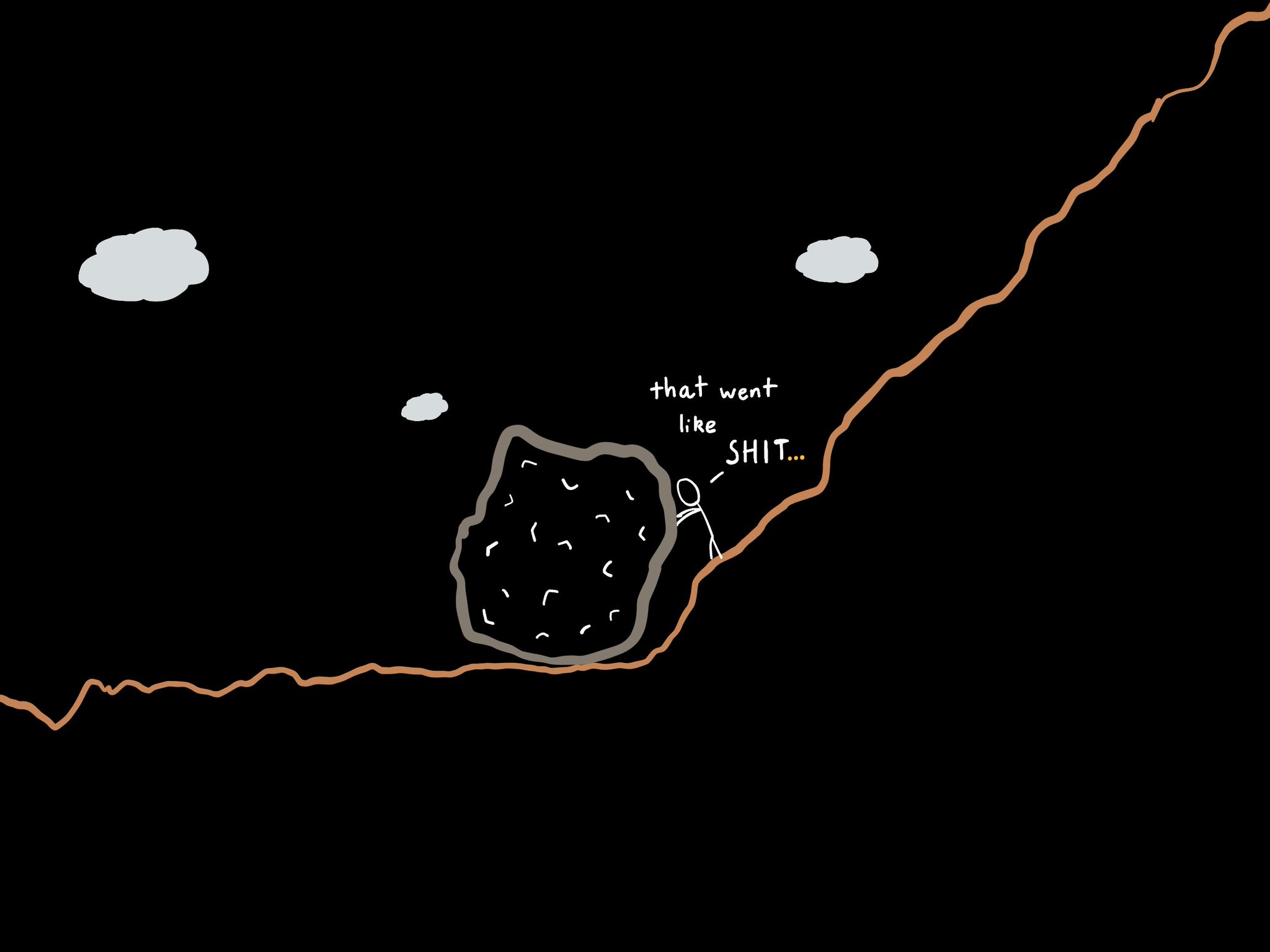
原图中的“that went like SHIT…”意为“刚才那次糟透了……”:回顾尝试,从反馈中调整。
Sisyphus was condemned to push a rock up hill for eternity.
西西弗斯被惩罚,要永远把石头推上山。
We all know that story by now. Everyone talks about it online.
这个故事我们都已经听过了,网上到处都有人谈论它。
But what if the most important moment is his walk back down?
但如果最重要的时刻,其实是他走回山下的那段路呢?
His “hour of consciousness” as Camus calls it. Where he’s fully aware of the activity he’s doing, and keeps doing it anyway?
那是加缪所说的“意识清醒的时刻”:他完全明白自己正在做什么,却仍然继续做下去。
Camus wrote we must imagine Sisyphus happy. Because happiness doesn’t come from the outcome itself but from taking the risk and responsibility of moving toward it.
加缪写道,我们必须想象西西弗斯是幸福的。因为幸福并非来自结果本身,而是来自承担风险与责任,朝着结果前进。
Iteration IS the walk back down the mountain.
迭代,就是走回山下的过程。
You reflect.
你反思。
You see what worked.
你看清哪些做法有效。
You make an educated adjustment.
你根据已有认识做出调整。
You push again.
你再推一次。
The SOP is the route up the mountain (your goal/outcome), and the walk back down is your review of the push (iteration).
SOP 是通往山顶,也就是目标或结果的路线;走回山下,则是对刚才那次推石过程的复盘,也就是迭代。
No matter what you do you’re pushing a rock.
无论你在做什么,你都在推着一块石头。
You are aiming toward various outcomes in your life even if you haven’t consciously chosen any.
即使你从未有意识地选择过,你的生活也在朝着各种结果发展。
Whether it’s voluntary, meaningful, chosen outcomes, or involuntary ones, because you never decided to do the dirty work of getting more specific than most people are willing to be, about what defines your definition of living a successful life.
这些结果可能是你自愿选择、对你有意义的,也可能是你被动承受的。后者的出现,是因为你始终没有下功夫,比大多数人更具体地弄清楚:在你自己的定义里,怎样才算活得成功。
You’re all in no matter what you do.
无论做什么,你投入的都是整个人生。
Pick your poison.
选择你愿意承受的苦吧。
(三)没人愿意做的那些繁琐工作
(c) The dirty work nobody wants to do
It’s not 10,000 hours.
关键不是一万小时。
It’s 10,000 iterations.
而是一万次迭代。
10,000 feedback loops. Learning loops.
一万次反馈循环,也就是学习循环。
Iteration does not mean repetition. Repetition is mechanical.
迭代不等于重复。重复是机械性的。
Iteration means doing something, pausing, reflecting, seeing how well it worked, making an adjustment, and going again ten thousand more times.
迭代意味着做一件事,停下来,反思,看看效果如何,做出调整,再继续这样做上一万次。
My golf breakdown wasn’t perfect. For me to make it better I would need to play lots of golf.
我对高尔夫目标的拆解并不完美。如果想改得更好,我就需要多打球。
I’d keep improving it.
然后持续改进它。
If I had more reps and feedback I would’ve broken it down better.
实践和反馈越多,我就越能把它拆解清楚。
All good and bad thoughts or feelings are feedback.
所有积极或消极的想法与感受,都是反馈。
Profound Idea: All good and bad thoughts and emotions are feedback.
**深刻想法:**所有积极或消极的想法和情绪,都是反馈。
Getting rejected is feedback, as is losing the jiu-jitsu tournament or hating going to the party or the pub last weekend.
被拒绝是反馈,柔术比赛输了是反馈,觉得上周末的聚会或酒吧之行令人讨厌,也是反馈。
There’s a cool idea from spiral dynamics (a model for how humans develop in response to problems) which states that people encounter the same problems at different levels of development, but with new levels of understanding from accumulated feedback.
螺旋动力学是一种解释人类如何在应对问题时发展的模型,其中有个很有意思的观点:人们会在不同发展阶段遇到同样的问题,但积累的反馈会让他们形成新的理解。
In simple terms, you face the same problems constantly, but every time you face them, again and again, you’ve evolved, so you confront them with more knowledge, understanding, and perspective for solving them successfully.
简单地说,你会不断遇到相同的问题,但每次再次面对时,你已经有所成长,因此能够用更多知识、更深理解和更多视角去解决它。
Instead of going around in circles you move up. Like a spiral.
你不再原地转圈,而是在向上走,就像螺旋一样。
If you lost motivation after a week of doing all this, that’s feedback. You might not be doing relevant activities or actions, or you just need to grow up and do the work. The work might just need doing. This is likely.
如果照着做了一周,你就失去了动力,这也是反馈。你做的活动或行动也许与目标无关;也可能你只是需要成熟一点,真正把活干了。有些工作就是必须做,这种情况很常见。
None of this is a fancy Notion template or productivity app. Which is why most people don’t want to do it (and would rather choose Notion templates and productivity apps that make you feel productive instead of being productive).
这里没有华丽的 Notion 模板,也没有什么效率应用。这也是为什么大多数人不想做,反而愿意选择那些让自己感觉有效率、却不一定真正有效率的模板和应用。
It’s ugly. It’s actually very boring and not sexy. It requires the dirty work of writing down your outcome super clearly. Every activity, every single action, every time for each action, and iterating each based on feedback.
它并不漂亮,实际上很枯燥,也不吸引眼球。你需要下笨功夫,把预期结果写得极其清楚:每项活动、每个具体行动、每项行动所需的时间,以及怎样根据反馈逐一迭代。
But it works in a way that would make you question the online productivity space itself and how fucking pointless most of it is.
但它的效果,会让你开始怀疑整个网络效率圈,以及其中大部分内容到底有多么无用。
Keep capturing feedback on your phone in a notes app. One document, call it “Feedback.”
继续在手机备忘录里记录反馈,用一份文档就好,名字就叫“反馈”。
Hand it to an AI chat along with your SOP document.
把它和 SOP 文档一起交给 AI 对话。
That should be one doc too.
SOP 也应该集中在一份文档里。
Update your SOP weekly.
每周更新一次 SOP。
Do it in minutes, not hours (thanks to AI).
借助 AI,用几分钟完成,而不是几个小时。
Always experiment with adding and cutting away 10% here and there, and please remember that this will never be perfect. There’s no finish line with this because it will keep evolving as you do.
不断尝试在不同地方增加或删去约 10% 的内容,也请记住,它永远不会完美。这里没有终点,因为它会随着你的成长继续演变。
You will not believe how much clarity you will gain from doing this.
你会惊讶于,这样做能让思路变得多么清晰。
Let alone how much you can achieve in 2-3 months.
更不用说,两三个月里你能取得多少成果。
I’ve given you my knowledge.
我已经把自己知道的方法告诉你了。
So how can you act on it as efficiently as possible right this second?
那么,此时此刻,你怎样才能最有效地将它付诸行动?
I’ve made an AI prompt that will guide you through making your very first SOP for achieving one specific goal you have.
我制作了一份 AI 提示词,可以引导你为一个具体目标建立自己的第一份 SOP。
It will guide you through every step so you can just focus on executing with what you’ve learned.
它会带你走过每一个步骤,让你专注于运用刚刚学到的方法,开始执行。
You can keep that same AI chat somewhere safe and let that be your chat for updating your SOP weekly with feedback. It might take you a while to create your SOP, and it won’t be easy, but hey. Nothing that’s worth it is easy. Which is what separates most people from a select few people.
你可以把这段 AI 对话妥善保存下来,以后每周继续在同一段对话里,根据反馈更新 SOP。创建 SOP 可能需要一些时间,也不会轻松。但有价值的事,从来都不容易。这也正是大多数人与少数人之间的区别。
Thanks for reading.
感谢阅读。
You’re an absolute legend.
你真的很棒。
- Craig :)
—— Craig :)
P.S
附言
If you’d like to understand how I write these newsletters each week (for Substack and YouTube) you can check out The Profound Writer. It’s an evolving course for those looking to learn how to write long-form content people can’t help but read.
如果你想了解我每周怎样为 Substack 和 YouTube 创作这些通讯内容,可以看看 The Profound Writer。这是一门持续更新的课程,面向希望学会创作让读者忍不住读下去的长篇内容的人。
Feel free to check that out by clicking this sentence.